

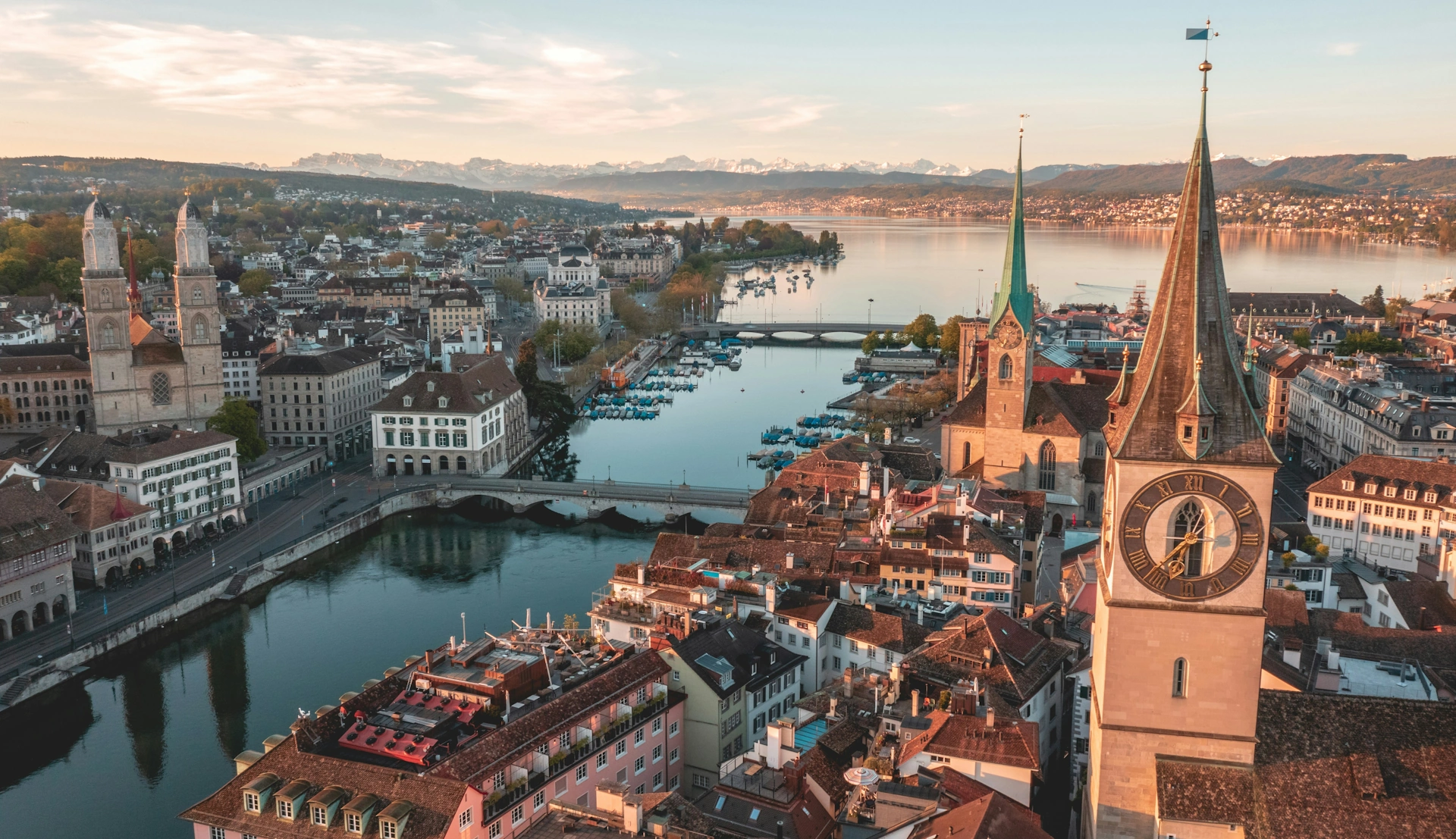
Switzerland
Spotlight Report by Samuel Bruce
Today is Swiss National Day, and congratulations are in order! The 2026 Legatum Prosperity Index reveals Switzerland to be the most prosperous country in the world. So what are the foundations of its success? And are there ways in which its world-leading prosperity could face challenges?
Switzerland's outstanding result is underpinned by superb scores across all domains and pillars of the Index. Its lowest pillar rank of 15 (out of 161 countries) for the Integrity of Families pillar is its only rank outside the global top 10.
It is in the top 10 of each of our three domains, a distinction shared with just two other countries: Ireland and Norway. It secures 1st place for the Freedom domain, 2nd for Development, and 7th for Society.
When considered as scores rather than ranks, its first place for Freedom is remarkable. With a score of 92.82, it is the only country in the world with a score in the top decile. It is also the only country whose freedom pillar scores are all above 90; 96.05 for Civil Peace, 91.46 for Freedom of Dissent, and 91.09 for Economic Freedom.
This cuts to the heart of its strong showing. Switzerland is as developed and socially cohesive as the Nordic countries in the top ten. However, whilst the Nordics tend to have high rates of tax, the Swiss have a considerably more favourable commercial environment.
Its exceptional economic freedom score is 7% higher than the next country in that pillar, Singapore. This is the highest margin of victory in any pillar covered by the Index. This result is underpinned by its strong performance across three of the four elements of this pillar. It ranks first for two of them: Legal Systems and Regulations. It ranks second for Sound Money, a strong rank underpinned by consistently low inflation. Its rigorous fiscal prudence, robust legal institutions and famously light-touch regulation have stood it in good stead. Switzerland's only mediocre rank in this pillar is its 100th place for Taxation.
It may be asked why this mediocre result for Taxation does not drag Switzerland down in the rankings. Whilst it is not as low tax as many other countries, it has a markedly low tax burden for comparable countries on other metrics within this pillar. See, for example, this plot of Taxation against Legal Systems:
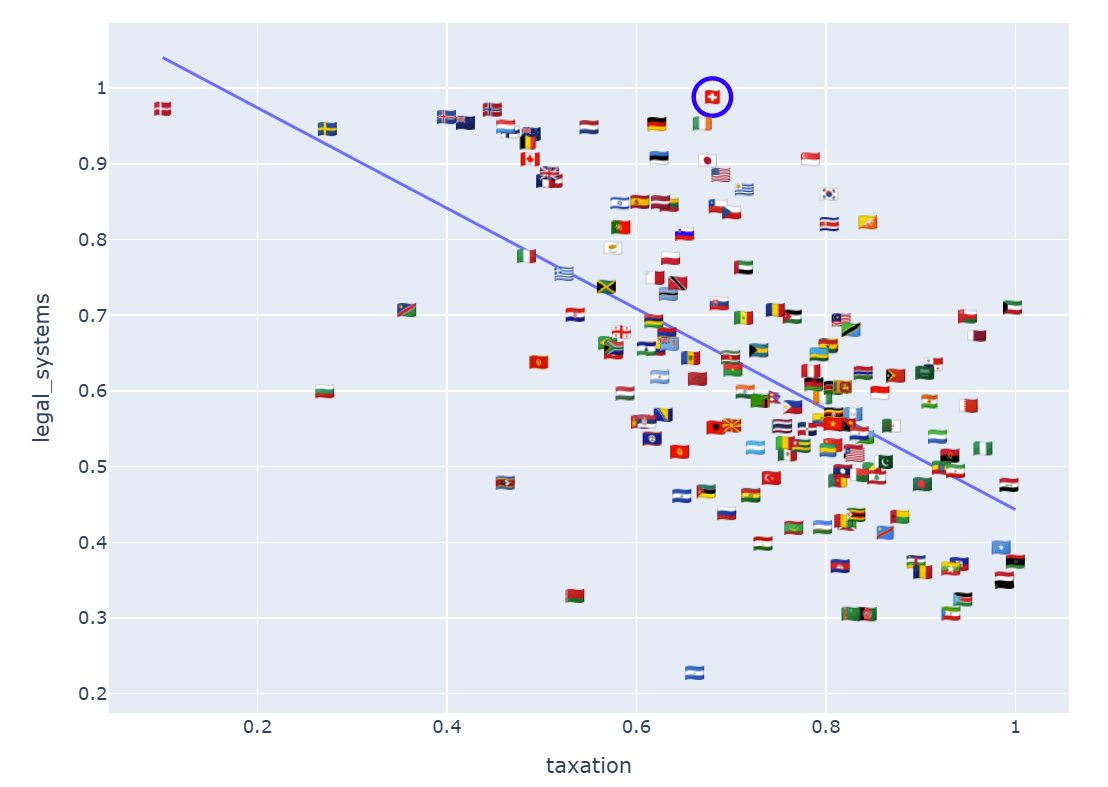
As this shows, scores for Taxation are negatively correlated with scores for Legal Systems: in other words, countries with better scores for their legal systems generally have worse scores for taxation. Indeed, as one can see, every country with a higher Taxation score than Switzerland has a lower score for Legal Systems, and every one of these whose ‘Taxation’ score is very strong (0.8 or above) has a greatly inferior Legal Systems score. Every country with a very high score for Legal Systems (above around 0.95) has a lower Taxation score, with most scoring very substantially lower. Only Ireland comes close.
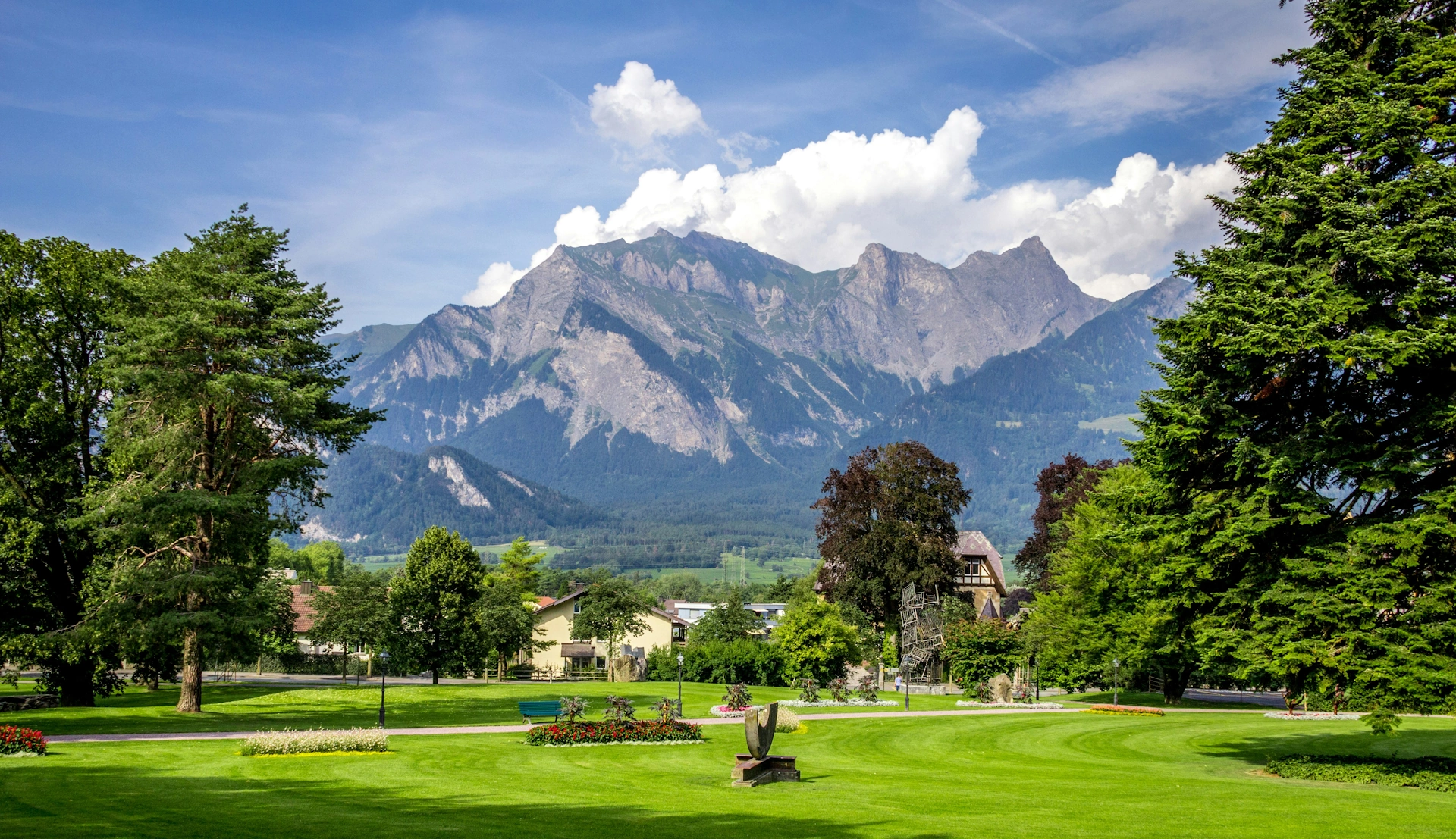
What has led to this remarkable set of results? Of course, Switzerland is a highly distinctive nation. Famous for breathtaking scenery, its Alpine culture is a uniting factor among a population otherwise divided by four national languages and two predominant Christian traditions. National sovereignty is taken seriously, and Swiss men residing in the country are required to complete military service.
A further uniting factor is a deep-rooted respect for craftsmanship and enterprise. This is reflected in the Swiss constitution: Article 27 states that “Economic freedom is guaranteed” and that this “[…] includes in particular the freedom to choose an occupation as well as the freedom to pursue a private economic activity”1. This acts as a constitutional guard against cumbersome regulations and licence rules.
Another factor that has maintained this over time is Switzerland's distinctive approach to governance. As one of the most decentralised countries in the developed world, many decisions are taken at the cantonal or lower levels of government. This means firms and residents can ‘vote with their feet’ between jurisdictions, and regulations are relatively adaptable to local circumstances. This incentivises competitive tax rates and regulatory environments.
For such a high-achieving country, one might wonder, is there anything wrong with it at all? As they say, et in Arcadia ego. Three points are worth highlighting.
Firstly, despite its excellent economic track record, it has not been immune to cost-push inflation. Strong energy security2 will have mitigated this, but nevertheless the particularly high levels of prosperity to which the Swiss middle classes have become accustomed are perhaps showing signs of reducing. The Swiss Federal Statistical Office revealed data recently that showed a “growing financial strain” hitting the middle classes, such that “[…] roughly one in four people in the lower middle class could not meet an unexpected CHF2,500 bill ($3,200)”3. The same article reports that “Nearly 260,000 people in the lower middle class said they had foregone a holiday for financial reasons”4.
Secondly, there are pressures on the decentralised governance model. Indeed, looking back over one and a half centuries, scholars have observed a “wide-ranging process of legislative centralization whereas the cantons have retained considerable administrative and, especially, fiscal autonomy”5. Some would prefer this centralization to accelerate, with more decisions to be taken at a national level. Switzerland has no national minimum wage, but in 2014 Socialist and Green parties supported a referendum proposal to introduce what would have been the world's highest.6
From outside, Switzerland has come under increasing pressure from European institutions to progress towards ‘dynamic alignment’ with EU regulations. As Anton Spisak of the Centre for European Reform notes, “Brussels grew frustrated by Switzerland's ‘pick-and-choose’ sectoral approach. In the EU's view, Switzerland benefited from reciprocal market access while retaining too much discretion in applying EU laws, without those laws being supervised and enforced by EU institutions.”7
On the other hand, proponents consider that decentralisation incentivises civic participation and collaboration across linguistic and confessional differences. This creates opportunities for the creative exchange of ideas with others from different perspectives, sharpening innovation. It also encourages competition between cantons to provide favourable business environments, stimulating commerce.
I would submit that the system of decentralised governance has stood the Swiss in good stead. Not for nothing has Switzerland been at the top of the rankings in every year since 2015. They should preserve this noble tradition of decentralisation and should have the courage to resist external pressure to deviate from it. In doing so, the Swiss will do a service to the rest of the world, demonstrating the power of supporting enterprise and the importance of preserving national sovereignty.
Finally, there is one datapoint that stands in stark contrast to Switzerland's otherwise outstanding showing: crime by foreign actors. In 2023, Switzerland had a score of 7.5 / 10 for this, quite a high score, according to the Global Organized Crime Index (GOCI). This has declined fractionally to 7.0 in new data not presently covered by our dataset, still placing Switzerland in the global top 40.
According to the GOCI, foreign criminal gangs are the driving force behind the trafficking of drugs, arms and people: “Switzerland is a destination for heroin, with ethnic Albanian groups and Italian mafias controlling distribution.”8 They report that “Cocaine trafficking has surged, with Switzerland emerging as a key transit point. The ‘Ndrangheta plays a central role, alongside other groups operating from South America.”9
In addition, the GOCI say “Switzerland has become an arms supply hub for criminal groups, including Italian mafia networks and outlaw motorcycle gangs, who exploit its flexible laws to acquire weapons. Cases of arms-store robberies by criminal groups from France, Belgium and Romania have been documented, with the stolen firearms entering the illicit market.”10
Further, Nigerian criminal groups were highlighted as active in people trafficking for sexual exploitation.11 Finally, they report that “The smuggling market has been growing, with Switzerland increasingly targeted by organized crime networks, with notable cases involving Iraqi Kurds and Afghan migrants being smuggled into Switzerland. The use of high-quality forged documents has been observed in smuggling operations, particularly those originating from Southeastern Europe.”12
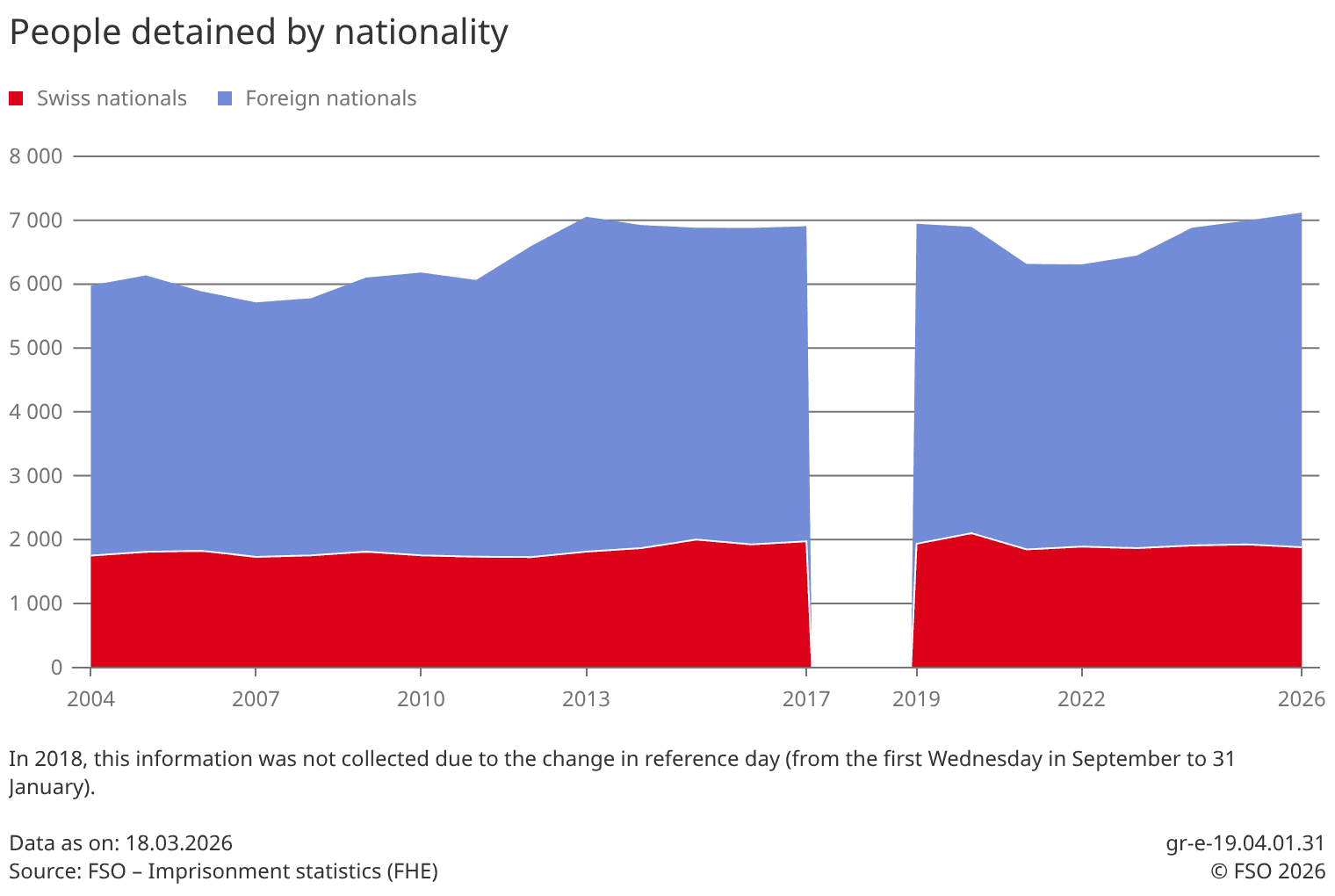
A brief review of Swiss prison population administrative data further demonstrates the issue of foreign criminal actors. In 2026, there were 1,881 Swiss nationals imprisoned whereas there were 5,238 foreign nationals in Swiss prisons.13 Examining this trend over time, looking at prisoners serving for ‘sentences and measures’ reveals a gradual rise in recent years in the ratio of foreign prisoners to Swiss nationals, now exceeding 2.28 foreign prisoners for each Swiss national detained.14 The Swiss Federal Statistical Office provide a data table which makes clear the great extent to which foreign detainees outweigh Swiss detainees.15
Creeping centralisation (both through internal and international factors) and foreign crime are the principal threats to prosperity. The Swiss should not weaken the foundations of its remarkable prosperity. At the same time, liberty requires order and the Swiss should remain vigilant against foreign criminal actors.
Hearty congratulations are in order for Switzerland. This national day is a fine opportunity to reflect on what foundations have created Swiss prosperity and how this can be sustained in the future.
- Swiss constitution, English translation, Article 27. Link available here.
- Swiss Federal Council website, Switzerland's energy supply is assured, March 2026. Link available here.
- Swiss Info website, Growing financial strain hits Swiss middle class, May 2026. Link available here.
- Swiss Info website, Growing financial strain hits Swiss middle class, May 2026. Link available here.
- Dardanelli, P. & Mueller, S. Dynamic De/Centralization in Switzerland, 1848-2010. Publius: The Journal of Federalism, Volume 49, Issue 1, Winter 2019, Pages 138–165. Link available here.
- Philip Inman, Swiss to vote in referendum on world's highest minimum wage, The Guardian, 2014. Link available here.
- Anton Spisak, The new EU-Swiss deal: What it means and the lessons it holds for the UK-EU ‘reset’, Centre for European Reform web site, March 2025. Link available here.
- The Organized Crime Index 2025 web site, Switzerland Country Page. Link available here.
- The Organized Crime Index 2025 web site, Switzerland Country Page. Link available here.
- The Organized Crime Index 2025 web site, Switzerland Country Page. Link available here.
- The Organized Crime Index 2025 web site, Switzerland Country Page. Link available here.
- The Organized Crime Index 2025 web site, Switzerland Country Page. Link available here.
- Swiss Federal Statistical Office, data table Imprisonment, Prison population on reference day by type of detention and nationality - 2004-2026, published May 2026. Link available here.
- Swiss Federal Statistical Office, data table Imprisonment, Prison population on reference day by type of detention and nationality - 2004-2026, published May 2026. Link available here.
- Swiss Federal Statistical Office, chart People detained by nationality - 2004-2026, published May 2026. Link available here.

