

The V4 Countries
Spotlight Report by Alexander Baker
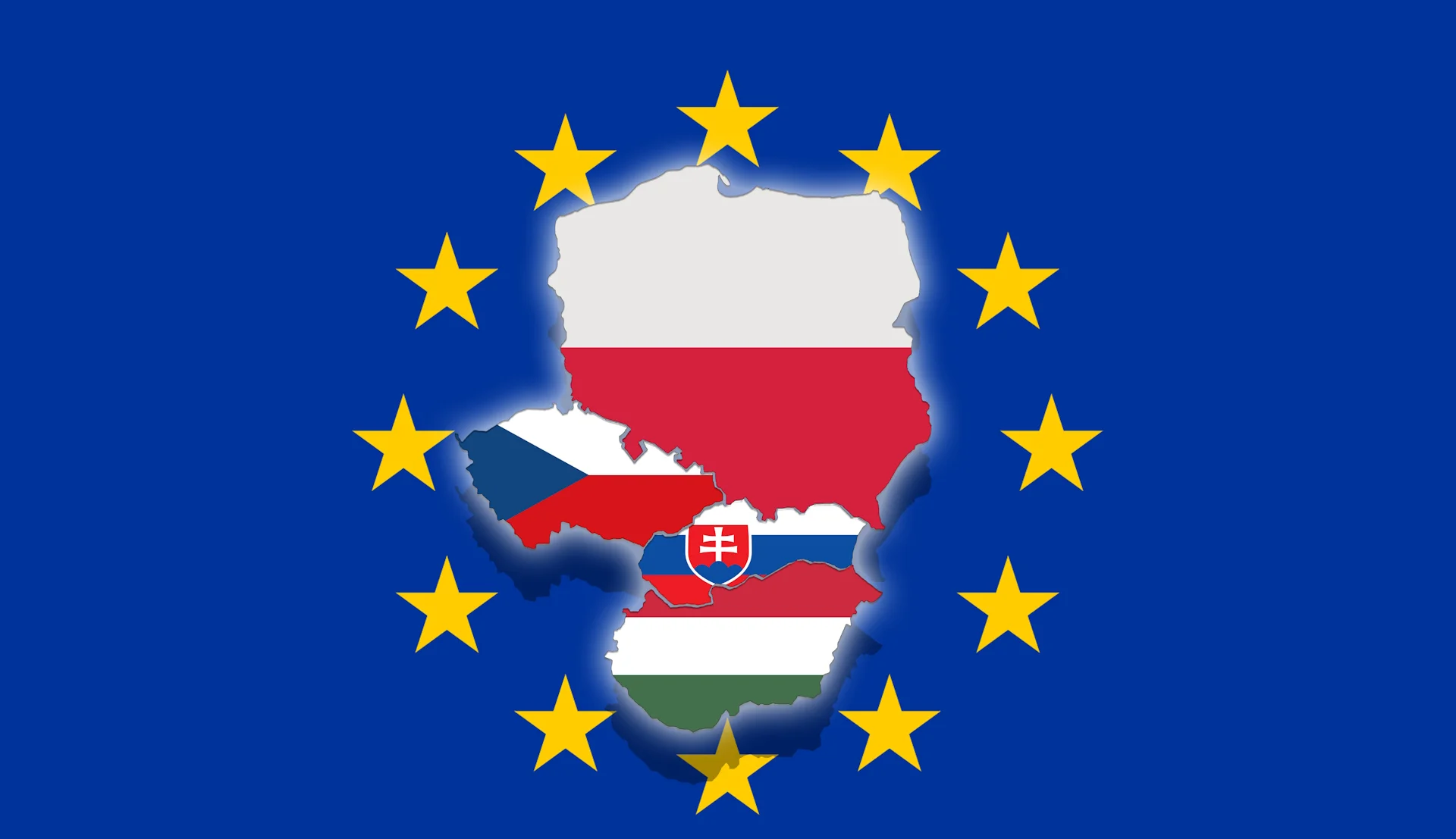
When the four countries of Central Europe, the Czech Republic (rank 20), Poland (rank 36), Slovakia (rank 35), and Hungary (rank 47), formed the Visegrád Group in 1991, they shared a common point of departure: the promise of democratic governance and the aspiration to build prosperous market economies rooted in the rule of law. More than three decades on, the four nations have taken different paths. While headline GDP figures have greatly improved, the countries' diverging institutional and social policies may determine whether their prosperity is durable.
All four V4 countries have recorded significant economic growth since the post-communist transition, though progress has varied. By 2024, the Czech Republic had closed the gap with Western Europe to the point where its GDP per capita was less than 10% below the EU average placing it close to France, Italy, and Spain, and representing steady improvement from the 78% of the EU average it recorded when it joined in 2004. Poland, Slovakia, and Hungary, by contrast, all remain between 20% and 30% below the EU average, having made real but more modest gains over the same period. Poland has been the most dynamic of the three, achieving consistent growth through and after the 2008 financial crisis, while Hungary has broadly stagnated and sits at the bottom of the V4 on wages and household incomes.
The four countries have followed different economic policy frameworks. The Czech Republic has maintained a broadly liberal, export-oriented model anchored in manufacturing and engineering, with prudent fiscal management and deep integration into German and Western European supply chains. Its relatively flat tax structure and low public debt have underpinned investor confidence, though it arguably suffers from underinvestment in R&D and a slow transition toward higher-value sectors.
Slovakia's economic model has been more interventionist in attracting foreign direct investment, particularly in automotive manufacturing, offering incentive packages that transformed its industrial base rapidly. The adoption of the euro in 2009 brought monetary discipline but also removed the exchange rate flexibility that smaller economies often rely on to absorb shocks. The result has been strong growth but persistent structural vulnerabilities, such as higher unemployment outside Bratislava.
Poland has pursued a model combining market openness with an active state role in social policy. Its large domestic market, well-developed service sector, and improving human capital base distinguish it from the other V4 members, whose smaller size makes them more dependent on export performance.
Hungary's economic policy has been the most distinctive and potentially contested. The government has pursued a strategy of economic nationalism: renationalising key industries, imposing sectoral taxes on banks and utilities and using state purchasing power to consolidate economic influence. While headline unemployment has fallen and wages have risen in nominal terms, these gains have come alongside growing concerns about market competition, the independence of regulatory bodies, and the allocation of public investment. The Prosperity Index ranks Hungary's property rights notably lower than its V4 peers (Hungary 113, Poland 42, Czech Republic 30, Slovakia 45), indicating a structural environment that, over time, tends to deter the high-quality investment that drives productivity growth.
Here, the Prosperity Index's subindices on economic freedom are instructive. The Czech Republic outperforms the others in terms of property rights, rule of law and contract enforcement, with Poland and Slovakia following and Hungary a distant fourth. Where these legal foundations are weakened, as Hungary and Slovakia's current trajectories suggest, the economic cost accumulates quietly but significantly.
The rule of law is underpinned by a question of social trust, and the willingness of citizens to trust one another, institutions, and collective outcomes. Hungary presents a complex case, as the Prosperity Index shows that Hungarians have low levels of confidence in both political institutions and interpersonal relations (Hungary 117, Poland 48, Czech Republic 37, Slovakia 92). This combination—high demand for state intervention on the one hand, and profound distrust of the state on the other—creates a social environment ill-suited to the civic participation and economic cooperation that sustainable prosperity requires. Low trust actively impedes economic development by raising transaction costs, discouraging cooperative behaviour, and weakening the social infrastructure on which markets depend.
The Czech Republic stands at the opposite end of this spectrum, with the Prosperity Index showing high levels of freedom (Hungary 75, Poland 42, Czech Republic 24, Slovakia 40), strong civil liberties, media independence, and legal protections. The picture remains more mixed for Poland and Slovakia with varying levels of freedom and social trust.
The V4 story is a lesson in the gap between economic output and economic sustainability. All four countries have grown since the post-communist transition, and all have made genuine progress in living standards. But the countries that have invested in transparent institutions, independent courts, and an accountable public sphere, above all the Czech Republic, and increasingly Poland, are building prosperity on firmer ground. In countries where governance issues persist, declining investment confidence, weakening social cohesion, and a growing deficit of the institutional trust may, in time, undermine the prospects of lasting prosperity.

